What Kids Are Really Learning When They Color
Downtime Coloring Books · August 29, 2026
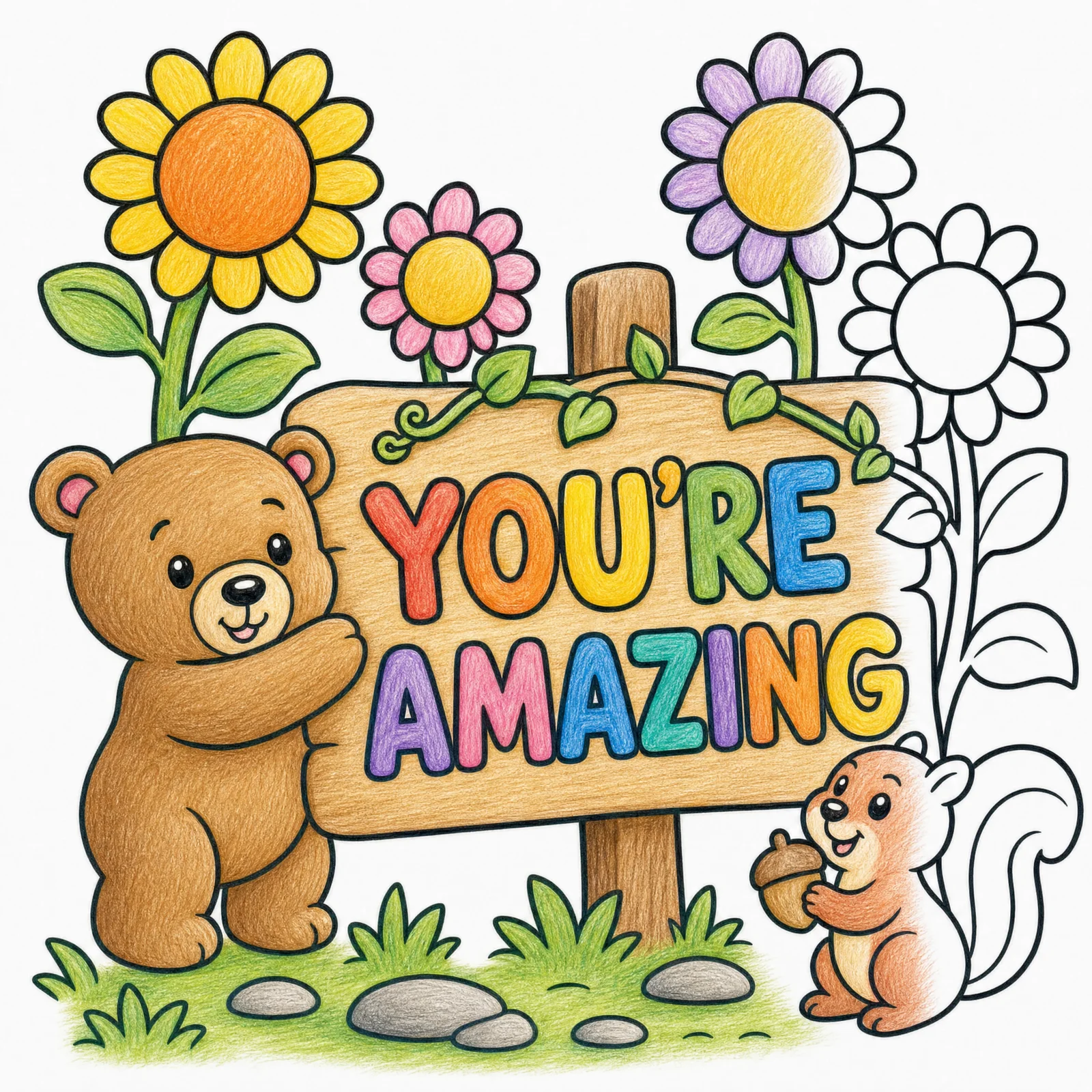
Coloring looks simple from the outside.
A child picks up a crayon, chooses a color, and starts filling in a picture. Sometimes they stay carefully inside the lines. Sometimes the color goes everywhere. Sometimes the blue sky becomes orange, the dog becomes purple, and the entire idea of realism is quietly abandoned.
That is part of the fun.
But while coloring may feel like pure play, it also gives children a surprisingly rich opportunity to practice how they use their hands, how they respond to what they see, and how they make choices of their own.
The important part is that none of this has to feel like a lesson.
Learning Through the Hands
One of the earliest things children are doing when they color is learning how to control a tool.
Very young children often begin with broad movements. They may hold a crayon in a fist and use much of the arm to make marks across the page. As they grow and gain control, those movements usually become smaller and more deliberate.
Coloring gives them a reason to keep practicing.
Following an edge, changing direction, filling a shape, stopping a stroke, or trying to reach a particular space all ask the eyes and hands to work together. Over time, those same kinds of movements become useful for other tasks that demand greater precision, including drawing, forming shapes, and eventually writing.
That is one reason Downtime Kids pages are designed with the coloring experience itself in mind. More detail is not automatically better. For younger colorists especially, clear shapes and comfortable spaces can provide plenty of useful practice without turning the page into a test of patience.
Children do not need to know they are working on coordination.
They just need something they want to color.
Experimenting With Cause and Effect
A crayon is a very simple tool, but it has a lot to teach.
Press lightly and the color changes.
Press harder and the mark becomes stronger.
Move quickly and the page looks different than when you move slowly. Go over an area twice and the result changes again.
Children discover these relationships naturally because the page responds immediately to what they do.
That kind of experimentation matters. It helps children understand that their movements have consequences and that they can adjust those movements to produce a different result.
The same is true of early scribbling.
Adults may see loops, streaks, or apparently random marks. For a young child, those marks can be part of learning that an action of the hand can create something visible on the page.
Over time, marks become more intentional. Shapes begin to mean things. Pictures begin to represent objects. Eventually, children encounter the much bigger idea that particular marks can stand for letters, numbers, and words.
There is a long road between scribbling across a page and writing a sentence.
Scribbling still belongs on the road.
Structure Without Taking Away Creativity
Coloring also occupies an interesting space between complete freedom and complete instruction.
The picture is already there, which makes it easy to begin. A child does not have to decide what to draw or confront an empty sheet of paper.
But the picture is not finished.
The child still chooses the colors.
They decide which part to begin with, what should stand out, whether anything should look realistic, and whether the castle urgently requires a fluorescent green roof.
Those decisions matter because they let children exercise preference and imagination inside a structure that feels manageable.
That balance is central to how Downtime approaches coloring for kids.
The page should offer enough guidance to make starting easy, but not so much that the child is merely executing somebody else’s instructions. A good coloring page leaves room for the person holding the crayon to make it theirs.
There is no correct color for most things on a Downtime page.
And if there were, children would probably improve it anyway.
A Picture Can Become More Than a Picture
Coloring also creates an easy opportunity for conversation.
Once there is a picture on the table, adults have something concrete to ask about.
What is happening here?
Where is this animal going?
How many flowers can you find?
Which shapes do you recognize?
Why did you make the moon green?
A child’s answers can turn the page into a story, a counting game, a conversation about colors, or an exercise in noticing shapes and details.
The trick is not to turn every coloring session into a classroom.
Children do not need a quiz disguised as leisure.
But when curiosity appears naturally, a coloring page gives parents and caregivers an easy way to follow it. A picture can invite storytelling, counting, vocabulary, observation, and imagination without any special preparation.
The activity simply grows in whatever direction the child takes it.
Making Something That Belongs to Them
There is another part of coloring that matters just as much as the skills being practiced: the finished page belongs to the child.
They chose the colors.
They made the marks.
They decided when it was finished.
That creates a small but real sense of ownership.
A completed page can be shown to someone, explained, displayed, given away, or proudly added to a growing stack of masterpieces.
And importantly, success does not need to mean technical perfection.
A child who colors carefully inside every line has made something.
So has the child whose enthusiastic red crayon crossed three borders and apparently continued into the neighboring province.
The useful response is often not “You stayed inside the lines.”
It is simply interest.
Tell me about this.
What did you make?
Which part do you like best?
That keeps the emphasis on participation, experimentation, and creativity rather than on performing the activity correctly.
Why Play Is Enough
Parents are often encouraged to look for educational activities, and understandably so.
But not every useful childhood experience needs to announce itself as educational.
Coloring is valuable partly because the learning is woven into the play.
A child may be practicing hand control while coloring a puppy.
They may be developing coordination while trying to reach a small corner.
They may discover how pressure changes a mark because one crayon suddenly looks darker.
They may count objects because someone casually asks how many they can find.
They may invent a story because the picture gives them somewhere to start.
None of that requires turning coloring into homework.
At Downtime Kids, that is the larger idea.
Children deserve downtime too.
Sometimes that means a quiet activity, a box of crayons, and a page they enjoy. If useful skills are developing along the way, all the better.
The learning does not have to replace the fun.
Very often, the fun is what makes the learning possible.