Why Coloring Makes Such Good Downtime
Downtime Coloring · August 8, 2026
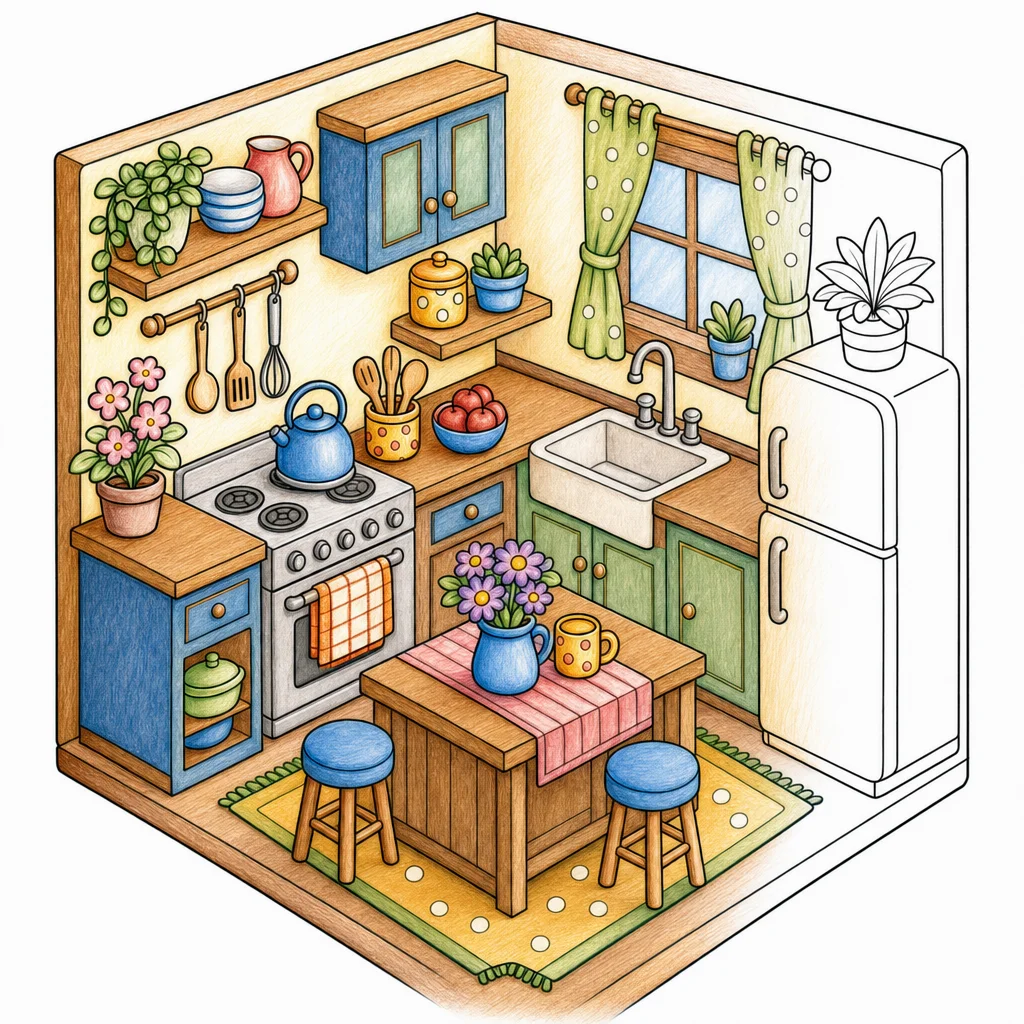
There is a simple reason coloring has remained appealing long after most of us stopped carrying crayons to school: it gives the mind something useful to do without asking too much of it.
That middle ground matters.
A blank sheet of paper can be intimidating. A screen can be endlessly distracting. Many hobbies require setup, instruction, equipment, concentration, or a significant block of time. Coloring asks for remarkably little. Open a book, choose a color, and begin.
The picture is already there. The decisions are yours.
That combination—structure without pressure—is a large part of what makes coloring such a satisfying form of downtime.
Creativity Without the Blank Page
Creative activities are enjoyable, but creating something from nothing can feel like work.
What should I draw? Where do I start? Is this any good?
Coloring removes most of those questions. Someone else has already created the framework. The lines give you a place to begin, but they do not tell you what the finished picture should look like.
That distinction is important.
At Downtime Coloring Books, we think of the illustration as the beginning of the creative process rather than the finished work. The page provides enough structure to make starting easy while leaving the most enjoyable decisions—the colors, combinations, emphasis, mood, and interpretation—to the person holding the pencil.
You do not have to prove that you can draw.
You just get to make the picture yours.
Just Enough Attention
Good downtime does not necessarily mean doing nothing.
Sometimes doing nothing leaves plenty of room for the mind to keep working: replaying conversations, constructing tomorrow's to-do list, or wandering back toward whatever occupied it five minutes earlier.
Coloring provides a different kind of break.
It requires attention, but usually not intense attention. You notice shapes. You choose colors. You follow an edge. You decide whether the next flower should be blue or orange, whether a castle belongs beneath a pink sunset, or whether a tiny reading nook desperately needs a green chair.
These are decisions, but they are pleasantly small ones.
That is one of the principles behind the different Downtime styles. Some people enjoy pages with elegant detail and plenty to explore. Others want bold lines, open spaces, and almost no fuss at all. Some want a charming room they can mentally move into for a while. Others would rather encounter an alien planet, a strange creature, or something completely unexpected.
There is no single correct level of complexity for downtime.
The useful level is the one that gives your attention somewhere comfortable to land.
The Lines Are Fixed. The Result Isn't.
Coloring is structured, but it is not standardized.
Give the same page to ten people and you can end up with ten remarkably different pictures.
One person sees an autumn garden. Another sees spring. Someone colors the entire thing in realistic shades while someone else decides that purple trees and a turquoise sky are obviously the correct answer.
Neither is wrong.
That freedom inside a defined space is one of coloring's quiet strengths. You are not confronted with infinite possibilities, but neither are you simply following instructions.
Downtime tries to preserve that balance.
The artwork needs enough personality to make you want to color it, but it should not feel so predetermined that the colorist is merely filling spaces. A good coloring page creates possibilities. It suggests a place, character, scene, pattern, or idea and then hands it over.
The printed page belongs to the book.
The finished page belongs to you.
A Deliberately Analog Activity
There are very few moments in modern life when our hands have nothing to do.
Unfortunately, the default answer has increasingly become a phone.
Waiting five minutes? Phone.
Commercial break? Phone.
Coffee cooling? Phone.
A few minutes before bed? Phone.
Coloring offers another answer.
It is physical in a modest but meaningful way. There is a book in front of you. There are pencils, markers, crayons, or gel pens nearby. Your hand is doing something. Your eyes are looking at paper rather than another illuminated rectangle.
That does not make coloring an anti-technology crusade. Downtime certainly isn't one. Technology helps create, discover, share, and enjoy all sorts of things.
But there is something valuable about an activity that works perfectly well without notifications, accounts, subscriptions, batteries, updates, or Wi-Fi.
Open the book.
Pick up a pencil.
That's the entire user interface.
Small Moments Still Count
Hobbies are often presented as commitments.
You should practice regularly. Build a dedicated workspace. Buy the proper equipment. Set aside an afternoon. Get serious about it.
Coloring does not have to work that way.
A page can take an evening. It can also be something you return to repeatedly for ten minutes at a time.
That idea is built into the name Downtime.
Downtime does not have to mean a vacation, an empty Saturday, or two uninterrupted hours with a perfectly arranged cup of tea. Sometimes downtime is simply the small space between one thing and the next.
Fifteen minutes before dinner.
A quiet half hour after everyone else has gone to bed.
A rainy Sunday morning.
A few minutes when you would otherwise scroll through something you will barely remember.
Those moments are real leisure too.
A coloring book can live comfortably inside them because there is almost no threshold for beginning and no penalty for stopping.
And Then There Is the Finished Page
There is another small pleasure that is easy to overlook: coloring produces something.
At the end of however much time you spend with the page, it is different because you were there.
You can look at it.
You can keep it.
You can show somebody.
You can decide that the orange was a terrible idea and then, two minutes later, decide that the orange actually makes the whole picture work.
It is a modest form of accomplishment, but modest accomplishments are allowed to feel good.
Not every worthwhile thing we do needs to improve us, optimize us, teach us a marketable skill, or become a serious pursuit.
Sometimes it is enough to take a black-and-white picture and make it colorful.
That's the Point of Downtime
We tend to describe leisure with big words: relaxation, mindfulness, wellness, creativity.
Those ideas may all have their place, but they can make a very simple activity sound more complicated than it is.
Coloring is enjoyable because it sits in an unusually comfortable space.
It is creative without demanding invention.
It occupies your attention without consuming it.
It provides structure without dictating the outcome.
It gives your hands something to do away from a screen.
And whether you spend ten minutes or an entire evening, you finish with something that did not exist in quite that form before.
Downtime Coloring Books approaches the page from that perspective.
The goal is not simply to give people things to color.
It is to create places worth spending a little downtime in.